
Why the Same Accommodation Doesn’t Work for Everyone Who Stays in it

Duration of stay is often treated as the defining characteristic of extended stay accommodation. However, it is only part of the picture.
Across Australia’s regional and suburban growth corridors, the people using extended stay accommodation are increasingly diverse in their circumstances, industries and day-to-day requirements. A healthcare professional on a specialist placement lives differently to a construction specialist on a multi-year infrastructure project. A family navigating an interstate relocation has different needs to a government contractor on a solo assignment.
Yet traditional accommodation models often treat all extended stay residents the same, offering standardised rooms designed for short-term convenience rather than day-to-day living. That approach begins to break down when people are no longer simply visiting a place but need to live there for weeks or months at a time.
At Extended STAY Australasia, this is something we consistently see across our portfolio. In 2025, more than 74% of our residents were corporate and government travellers, with only a small proportion made up of leisure stays. But within that majority cohort, the profiles, routines and expectations vary considerably.
In regional hubs like Mackay, Townsville and Whyalla, demand is driven by project-based workers connected to natural resources, infrastructure delivery, defence and essential services. Their schedules are demanding, physically intense and involve irregular hours. What matters most at the end of the day is not luxury, but recovery – a calm space to decompress, a home-cooked meal and a quiet environment to sleep and reset.
In suburban locations like Abbotsford, Hawthorn, Kew and Williamstown, the mix shifts. Medical professionals on specialist placements, corporate relocations, government personnel, and families transitioning between homes all bring different routines and expectations. The work patterns change, the pressures change, and the accommodation needs change with them.
A family with children has entirely different day-to-day requirements to a solo contractor. A healthcare worker on rotating shifts lives differently to a corporate professional working standard hours. Recognising these differences, and designing around them is what separates purpose-built extended stay accommodation from accommodation that simply allows people to stay longer.
The challenge is that much of the accommodation traditionally used for extended stays was never designed for extended living. A standard hotel room may work for a few nights, but over several weeks or months the limitations become clear: limited space, no separation between work and rest, minimal cooking facilities, and little ability to maintain routine. What works for a transient traveller does not necessarily work for someone building a stable day-to-day life away from home.
Design needs to account for how people move through a space, how long they stay and, in some cases, accessibility requirements that become more important over extended periods. When accommodation is used as a place to live, even temporarily, these factors shape how functional and comfortable the experience is on a daily basis.
That is why features such as full kitchens, separate living and sleeping zones, and reliable workspaces are not premium additions. For long-stay residents, they are the infrastructure of daily life. A kitchen is not a convenience when you are managing meals over several months away from home. A quiet, well-designed space can be the difference between rest and fatigue for someone working demanding or irregular hours. A dedicated work desk becomes essential when productivity is part of the reason for the stay.
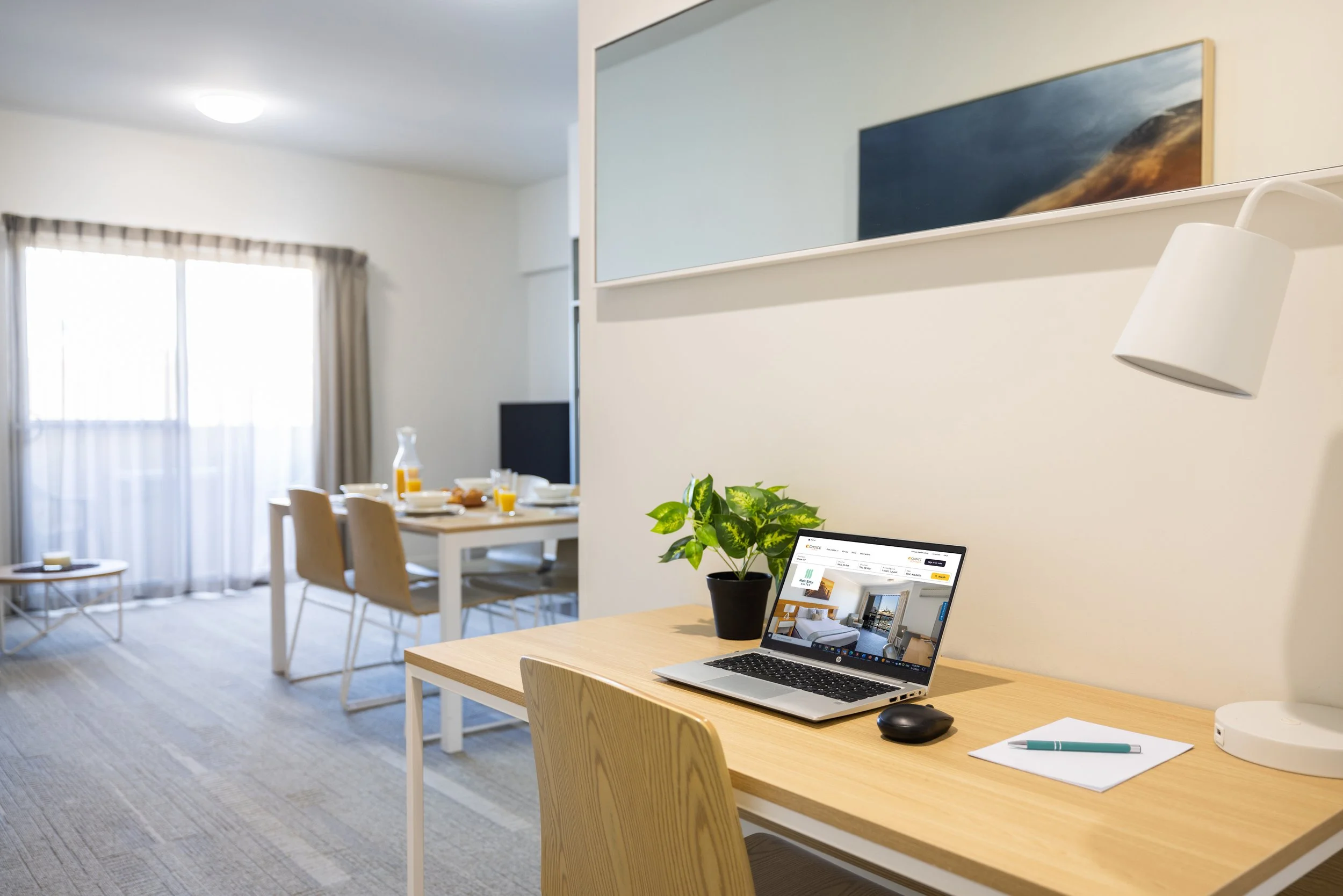
But functionality alone is not enough. Extended stay residents also value familiarity, routine and human connection. Over time, the small things become the things people remember most.
We regularly hear feedback that reflects this. “We come here every year, and it feels like coming home.” Another resident recently told us, “Lisa is amazing and always looks after us — we feel part of the family.”
Those responses reflect something important about extended stay living. When someone is away from home for weeks or months at a time, consistency and familiarity matter just as much as the physical amenities.
Location also shapes the resident experience. A mining corridor has different requirements to a healthcare precinct. A port town attracts a different workforce to a regional university city. Effective extended stay development requires understanding not just where a property sits, but who will be living there and what their daily life looks like.
This thinking underpins the MainStay Suites model, introduced to Australia through Extended STAY Australasia’s partnership with Choice Hotels Asia-Pac. The model provides consistency where it matters most, while allowing local knowledge to shape the experience around it. Residents benefit from a globally recognised extended stay approach, while each property reflects the needs of its local community and workforce.
Extended stay demand across our regional portfolio has grown by 93.6% since 2022. The demand is clearly there. The opportunity now, for councils, investors, developers and organisations alike, is to ensure accommodation is designed around how people actually live.
Ultimately, extended stay accommodation only works when it reflects the people living in it, not a simplified view of the long-stay resident.
For investors, developers, councils, government bodies and organisational partners ready to explore the opportunity in purpose-built extended stay accommodation, we welcome the conversation.
Contact us at: enquiries@extendedstayau.com.au